
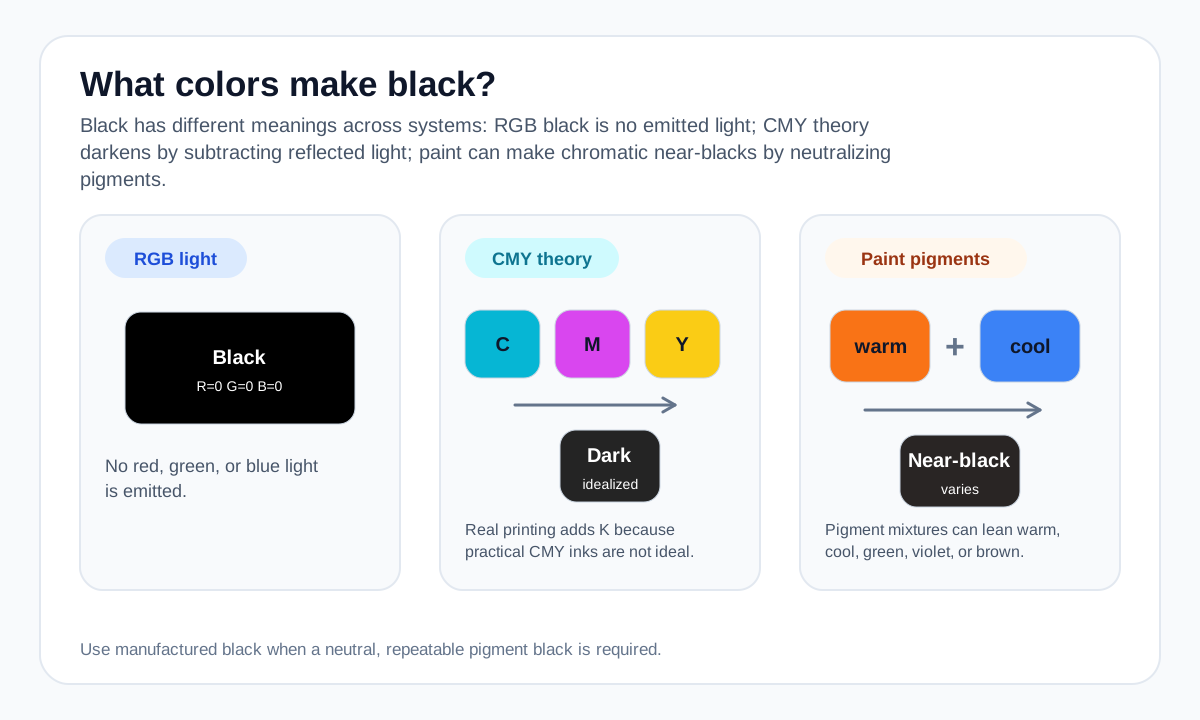
For artists, one common approach is to mix complementary colors until they neutralize into a very dark value. The result can be visually richer than tube black, but it is not guaranteed to be perfectly neutral.
For web and UI work, use a chosen RGB/HEX dark value directly. #000000 is mathematical screen black; near-black values can be selected intentionally when a softer appearance is preferred.
Practical mixing routes
- For reliable painting, a black pigment is the most repeatable starting point.
- A very dark neutral can also be approached by balancing complementary colors, but the result depends strongly on the pigments.
- In theoretical CMY subtraction, combining cyan, magenta, and yellow moves toward black; practical printing adds a separate K channel because real inks are imperfect.
How to adjust the result
Let a red/brown direction remain slightly dominant.
Let a blue direction remain slightly dominant.
Use a very dark neutral rather than absolute black when the design calls for less visual harshness.
Common mixing mistakes
- Expecting three arbitrary paints mixed together to produce a clean neutral black.
- Using screen #000000 as though it describes a physical pigment mixture.
- Adding more colors indefinitely after the mixture has already become muddy.
Why the answer changes by color model
In additive RGB, black is the absence of red, green, and blue light. In subtractive ink theory, combining cyan, magenta, and yellow removes more reflected light. Real printing adds a dedicated black (K) ink because practical inks are not ideal.
A mixed chromatic black can lean warm, cool, green, violet, or brown depending on the pigments and ratios. Use a manufactured black when a neutral, repeatable black is required.
For a numerical screen-color blend, use the Digital Color Mixer. Its result is an RGB interpolation and should not be treated as a prediction of real paint or ink behavior.
Source and model notes
- Adobe — Primary colors guide — RGB additive light and CMY subtractive color-model relationships.
- Winsor & Newton — Colour bias in paint mixing — Why pigment bias changes the brightness and character of real paint mixtures.
Useful next steps
Compare a screen-color blend in the Color Mixer, or explore more mixing answers.