
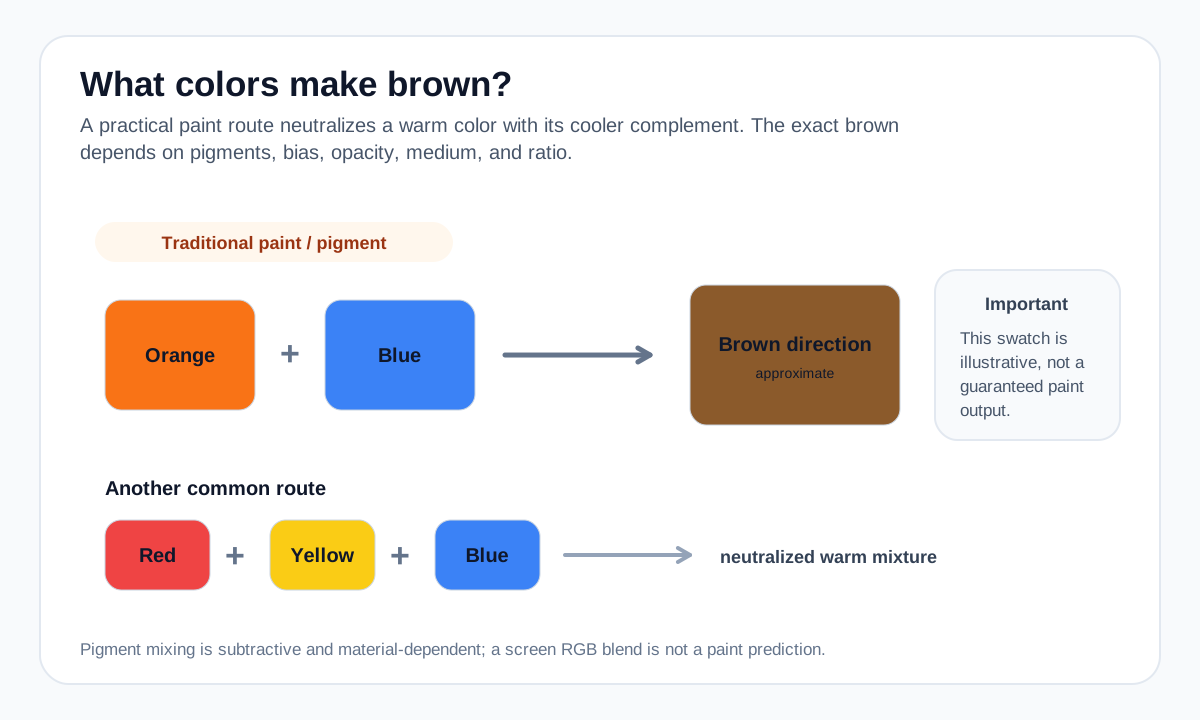
If you already have orange, add blue gradually rather than in one large step. If you start from primary colors, first make an orange-leaning mixture from red and yellow, then add enough blue to neutralize it toward brown.
A warmer brown uses more red or yellow; a cooler or grayer brown uses more of the complementary blue. For a repeatable digital color, choose the brown you want numerically instead of trying to infer a physical paint result from RGB values.
Practical mixing routes
- Start with orange, then add blue in small increments until the orange loses enough saturation to read as brown.
- Start with red + yellow to create a warm orange direction, then neutralize it gradually with blue.
- If you already have a brown, adjust that base instead of rebuilding it from primaries when repeatability matters.
How to adjust the result
Bias the mixture toward red or orange.
Bias toward yellow-orange while keeping enough neutralization to stay brown.
Add the complementary blue direction gradually and compare after each change.
For paint, mix toward white or a light neutral; expect saturation to change as well.
Common mixing mistakes
- Adding the complementary color too quickly, which can jump from warm brown to a dull gray.
- Assuming a 50/50 screen blend predicts a physical paint result.
- Treating one ratio as universal across pigment brands, opacity, and media.
Why the answer changes by color model
Traditional paint mixing is subtractive and pigment-dependent. A digital RGB interpolation between two sample colors is a different operation, so its HEX result should not be used as a promise of what physical paint will become.
There is no single exact “brown formula” across paints. Pigment bias, opacity, brand, medium, and mixing ratio can all change the result.
For a numerical screen-color blend, use the Digital Color Mixer. Its result is an RGB interpolation and should not be treated as a prediction of real paint or ink behavior.
Source and model notes
- Adobe — Primary, secondary & tertiary colors — Traditional RYB secondary-color relationships and the distinction from RGB color mixing.
- Winsor & Newton — Colour bias in paint mixing — Why pigment bias changes the brightness and character of real paint mixtures.
Useful next steps
Compare a screen-color blend in the Color Mixer, or explore more mixing answers.