
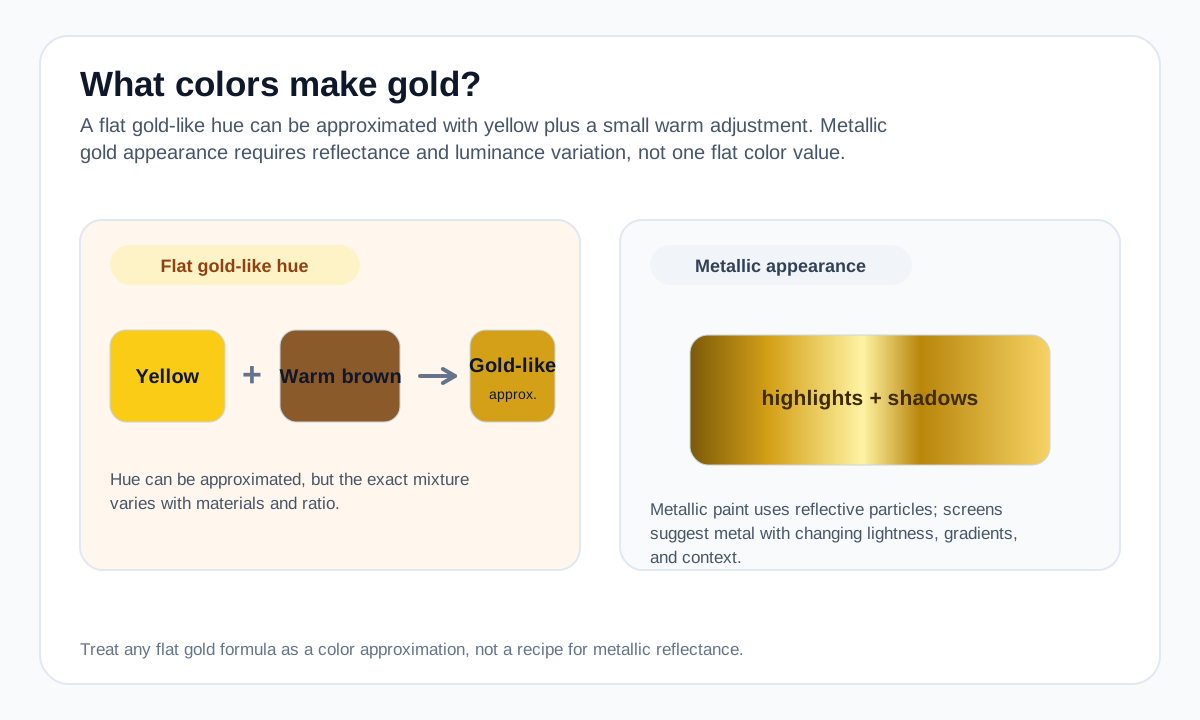
For non-metallic paint, start with a strong yellow and add very small amounts of orange or warm brown until the hue becomes richer and less lemon-like. Keep the dark component controlled because it can dull the color quickly.
For digital design, a single gold HEX is only the base hue. If the goal is a metallic impression, use tonal variation and lighting cues rather than expecting one flat color to look like reflective metal.
Practical mixing routes
- For a flat non-metallic gold hue, begin from yellow and move toward orange/brown until the color reads warmer and deeper.
- For actual metallic paint or ink, use a metallic product when reflectance is part of the goal; a flat RGB/HEX value cannot reproduce metallic behavior.
How to adjust the result
Keep the hue closer to yellow and raise lightness.
Shift toward darker orange-brown while preserving a yellow bias.
Use gradients, highlights, shadows, and texture in addition to a base gold color.
Common mixing mistakes
- Treating #FFD700 as a simulation of real metallic gold.
- Adding dark color too quickly and ending up with brown instead of gold.
- Assuming one physical recipe works across metallic pigments, standard paints, inks, and screens.
Why the answer changes by color model
A screen can display a gold-colored flat swatch, while a metallic look is usually suggested with highlights, shadows, gradients, and texture. Physical metallic paint relies on reflective particles or metallic pigments.
There is no universal “gold mixture” because metallic appearance depends on reflectance and lighting as well as hue. Treat any flat gold recipe as a color approximation.
For a numerical screen-color blend, use the Digital Color Mixer. Its result is an RGB interpolation and should not be treated as a prediction of real paint or ink behavior.
Source and model notes
- Winsor & Newton — Colour bias in paint mixing — Why pigment bias changes the brightness and character of real paint mixtures.
Useful next steps
Compare a screen-color blend in the Color Mixer, or explore more mixing answers.