
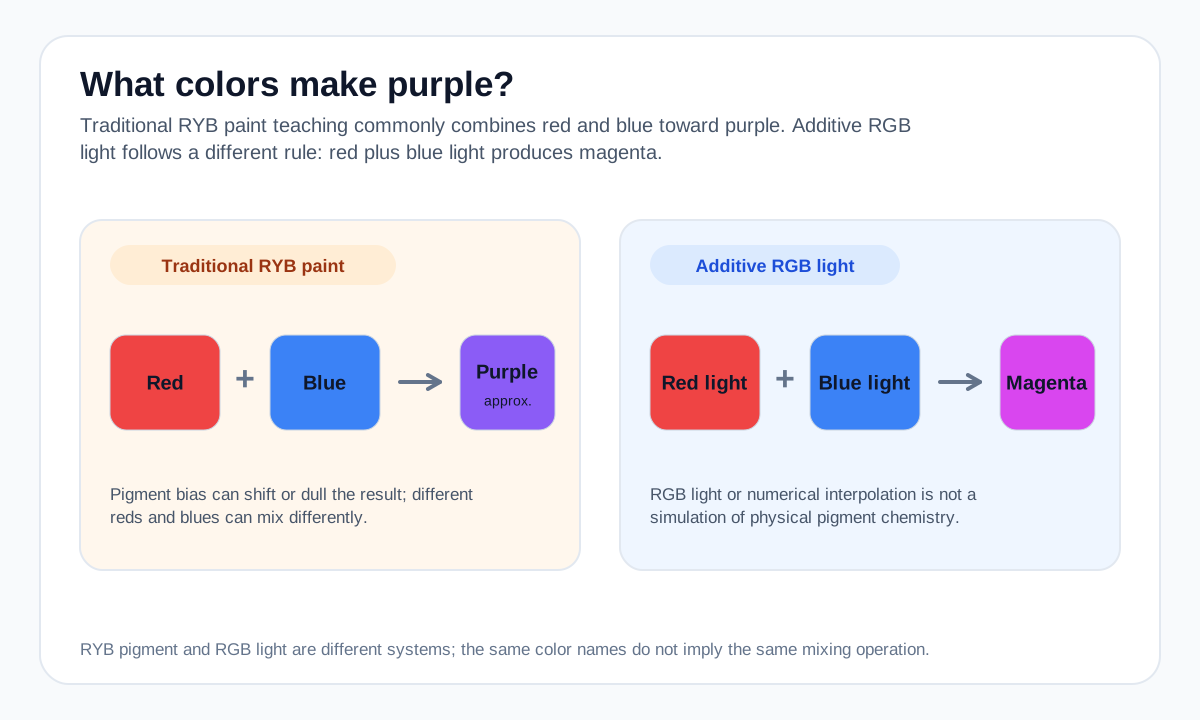
For paint, begin with a roughly even red-and-blue mixture and then adjust the ratio. More red pushes the result toward red-violet; more blue pushes it toward blue-violet.
If the mixture looks muddy, changing the specific red or blue can matter more than changing the ratio. Pigment bias determines whether extra complementary color is being introduced into the mix.
Practical mixing routes
- For a traditional RYB paint approach, combine red and blue, then adjust the balance by eye.
- Start with a violet/purple pigment when you need repeatability, then use red or blue only for directional adjustment.
How to adjust the result
Increase the red-biased side of the mix.
Increase the blue-biased side.
Mix toward white for a lavender direction; physical paint may lose chroma as it lightens.
Common mixing mistakes
- Assuming any red + any blue will make the same purple; pigment bias can introduce unwanted yellow/green components.
- Trying to fix a muddy purple only by changing the ratio when the pigment choices may be the real cause.
- Using an RGB midpoint as a promise of physical pigment behavior.
Why the answer changes by color model
Traditional RYB and digital RGB do not use the same mixing rule. In additive RGB light, red and blue together produce magenta. A browser midpoint blend is an RGB interpolation, not a simulation of pigment chemistry.
A red with a yellow bias or a blue with a green bias can dull the mixture, so two paints labeled simply “red” and “blue” can make noticeably different purples.
For a numerical screen-color blend, use the Digital Color Mixer. Its result is an RGB interpolation and should not be treated as a prediction of real paint or ink behavior.
Source and model notes
- Adobe — Primary, secondary & tertiary colors — Traditional RYB secondary-color relationships and the distinction from RGB color mixing.
- Winsor & Newton — Colour bias in paint mixing — Why pigment bias changes the brightness and character of real paint mixtures.
Useful next steps
Compare a screen-color blend in the Color Mixer, or explore more mixing answers.