
Primary colors depend on the model
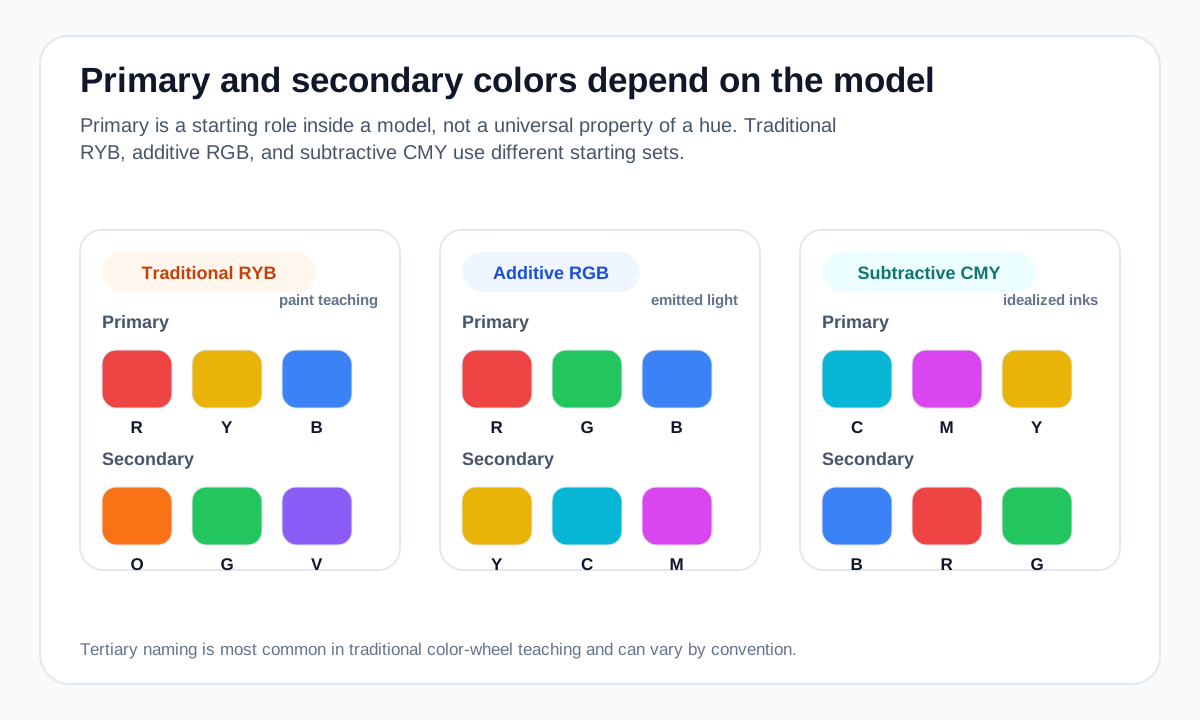
A primary color is a starting component within a particular model, not a universal list that applies to every medium. Traditional art teaching often uses RYB. Screens use additive RGB light. Printing workflows commonly use subtractive CMY with black added in CMYK.
Confusion appears when rules from one model are carried into another. For example, green is secondary in a simplified RYB wheel but primary in RGB light.
Secondary colors
Secondary colors are produced by combining pairs of primaries within the chosen model. In traditional RYB teaching, orange, green and violet are the familiar secondaries. In additive RGB, combining red and green light produces yellow, green and blue produce cyan, and blue and red produce magenta.
The word “secondary” therefore describes a relationship inside a model rather than an inherent property of the hue.
Tertiary colors
On the traditional RYB color wheel, each tertiary hue sits between one primary and its neighboring secondary. The six commonly taught RYB tertiary colors are:
- Red-orange: between red (primary) and orange (secondary).
- Yellow-orange: between yellow (primary) and orange (secondary).
- Yellow-green: between yellow (primary) and green (secondary).
- Blue-green: between blue (primary) and green (secondary).
- Blue-violet: between blue (primary) and violet (secondary).
- Red-violet: between red (primary) and violet (secondary).
For example, if you already have orange paint, shifting it toward red makes a red-orange direction; shifting it toward yellow makes yellow-orange. The exact result depends on pigment and proportion. These six labels are a traditional RYB teaching convention, not a fixed list of sRGB codes or a universal set of tertiary names across RGB and CMY models.
Why this matters for Colormapped tools
Digital HEX/RGB converters operate on sRGB values, while paint-mixing explanations are approximate and pigment-dependent. CMYK conversions are also output-dependent in real print workflows.
Keeping the model explicit prevents a valid rule for light from being presented as though it were a recipe for paint.
Worked example: keep the color model explicit
The word “primary” changes meaning with the model, so a useful reference labels the model beside the colors.
Additive light model used by screens
Idealized subtractive model
Common art/paint teaching model
There is no contradiction in these different primary sets: they describe different mixing models and starting assumptions.
Useful tools
Sources and method
- Adobe — Primary colors guide — Primary/secondary relationships and additive versus subtractive color models.
- Adobe — Colour wheel combinations — Color-wheel relationships including analogous, triadic, tetradic, warm and cool groupings.
- Adobe Photoshop — Understanding color modes — RGB and CMYK color-mode behavior and print/screen workflow context.