
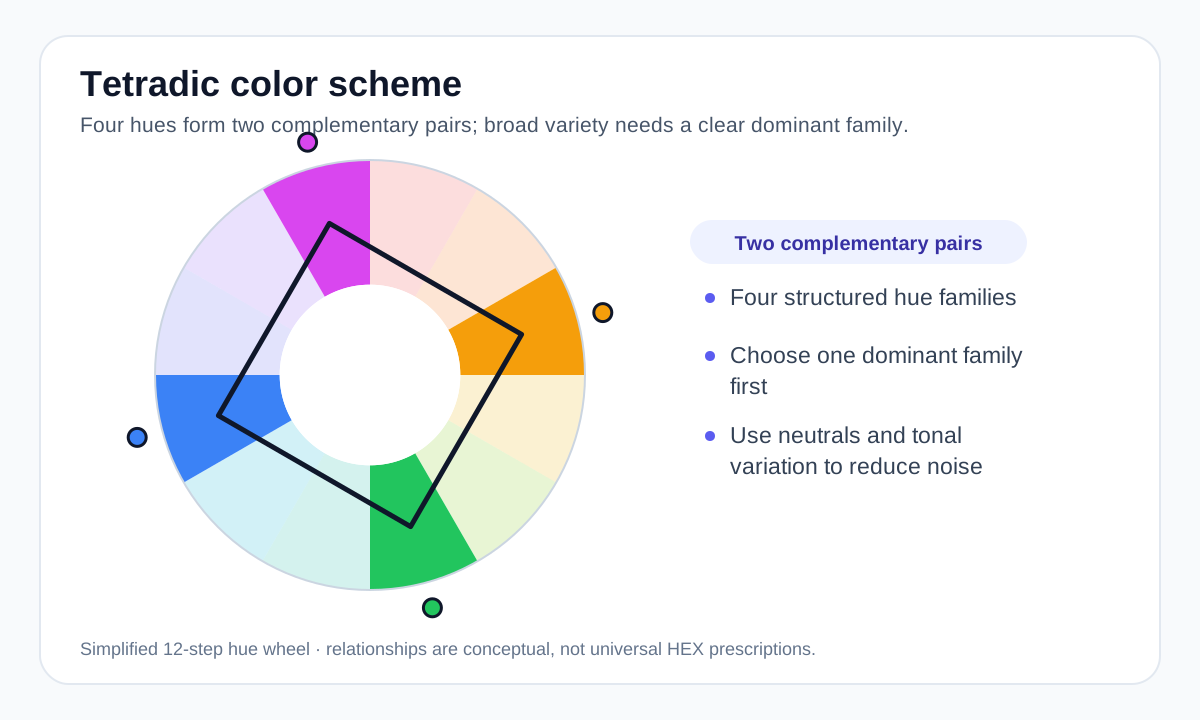
What makes a tetradic scheme
A tetradic relationship combines two complementary pairs. Some references describe a rectangular tetrad separately from a square scheme, but both use four hues with structured spacing around the wheel.
Because there are more hue families than in analogous, complementary or triadic schemes, tetradic palettes can become visually busy quickly.
Choose a dominant color first
Do not begin by assigning equal importance to four saturated colors. Choose one as the dominant family, one as the main supporting family and keep the remaining pair for smaller accents or specific states.
You can reduce complexity further by using pale tints of some hues and reserving full saturation for one or two focal colors.
Read the worked example as two opposing hue pairs
In the example below, amber sits opposite blue on an HSL hue wheel, while berry sits opposite green. The complementary hue angle is 180° for each pair; the HEX values are sRGB examples, not exact predictions for paint mixing or proof that a particular text/background pairing meets accessibility contrast requirements.
Control lightness as carefully as hue
Four distinct hues do not guarantee usable hierarchy. Build a tonal structure so surfaces, text and controls remain easy to distinguish. Neutrals are often essential in a tetradic system because they give the colors room to work.
For data visualization, verify that categories remain distinguishable under color-vision differences and add direct labels where possible.
Best use cases
Tetradic schemes work well when a project genuinely benefits from broad color variety: illustration, dashboards with multiple categories, event graphics or expressive identities.
If you only need one dominant and one accent color, a simpler harmony is usually easier to manage.
Worked example: two complementary pairs with hierarchy
A tetradic scheme becomes easier to use when one pair dominates and the second pair is reserved for smaller accents.
#2563EB Dominant hue #EBAD25 Blue complement · +180° HSL #16A34A Secondary hue #A3166F Green complement · +180° HSL #334155 Neutral structure The blue–amber and green–berry pairs are opposite in HSL hue (180° apart each). This geometric relationship does not guarantee text contrast or reliable physical paint mixing; use neutral space and check exact color pairs for accessibility.
Useful tools
Sources and method
- Adobe — Colour wheel combinations — Color-wheel relationships including analogous, triadic, tetradic, warm and cool groupings.
- W3C WAI — Understanding Contrast (Minimum) — WCAG text contrast thresholds and guidance.